
- Engineering Technology and Commonwealth Engineering
Biomedical Engineering Technology
Technicians in the biomedical engineering technology field are highly skilled, trained professionals who are responsible for functional and safety inspections, preventive maintenance, calibration, troubleshooting, equipment repair, and the training of hospital personnel in the safe and proper use of medical equipment.
The Biomedical Engineering Technology Program at Penn State Greater Allegheny prepares students to pursue various careers within the Healthcare Technology Management field, including:
- Biomedical Engineering Technician/Clinical Engineer in a Hospital
- Field Service Technician
- Repair Technician for a Medical Device Company
- Imaging Engineering Technician
- Device Integration Analys
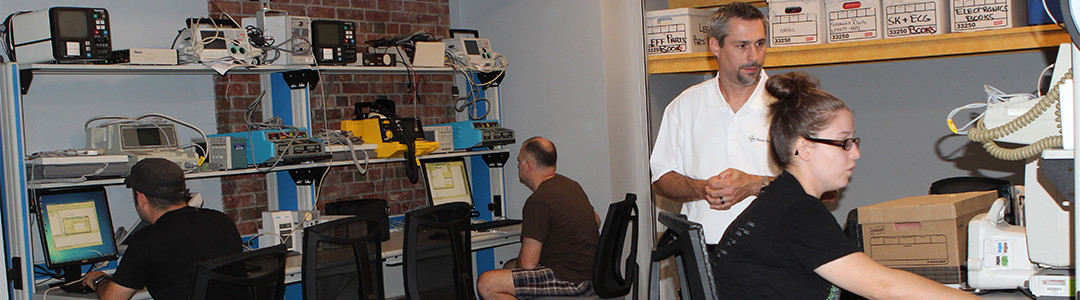
The classroom and laboratory portions of this major focus on electronically and PC based medical devices for patient monitoring and life-support equipment. The student is exposed to a much broader spectrum of medical equipment through a 400-hour (ten-week) practical internship in an approved health care facility.
The first year of the BET program can be completed at the Altoona, Beaver, Behrend, Berks, and Greater Allegheny campuses. The second year is available only at the Greater Allegheny campus.
The A.ENGT. in Biomedical Engineering Technology is accredited by the Engineering Technology Accreditation Commission of ABET, under the commission's General Criteria and Program Criteria for Healthcare Engineering Technology and Similarly Named Programs.
Program Educational Objectives
The Biomedical Engineering Technology program is designed to provide a curriculum that prepares students to pursue a career in the evolving healthcare technology management (HTM) field and to develop in their profession. Due to their experience in our program, within few years of graduation, we expect our graduates will have:
- Demonstrated proficiency in installing, performing acceptance testing and preventive maintenance (PMs) inspections, troubleshooting, repairing, and performing network integration on a wide variety of medical devices using standards, regulations, and quality improvement plans.
- Shown the ability to adapt to evolving technologies and effectively apply engineering technology knowledge and tools in the healthcare technology management (HTM) field.
- Engaged in continuous learning through CBET (Certified Biomedical Equipment Technician) certification and/or other professional training programs and independent study.
- Worked both independently and collaboratively in multi-disciplinary teams, communicating effectively with clinical staff, related healthcare professionals, and administrative staff.
Student Outcomes
Student outcomes describe what students are expected to know and be able to do by the time of graduation. The biomedical engineering technology program is designed to enable students to:
- Apply knowledge, techniques, skills, and modern tools of mathematics, science, engineering, and technology to solve well-defined engineering problems appropriate to the discipline
- Design solutions for well-defined technical problems and assist with the engineering design of systems, components, or processes appropriate to the discipline
- Apply written, oral, and graphical communication in both technical and non-technical environments; and an ability to identify and use appropriate technical literature
- Conduct standard tests, measurements, and experiments and analyze and interpret the results
- Function effectively as a member of a technical team